Key points
- More customers now ask AI assistants for recommendations instead of scrolling search results.
- AI tools build answers from information that is already public: your website, Google profile, reviews and mentions elsewhere.
- Clear, consistent, specific information makes it easier for AI to recommend you.
- You can check your AI visibility the same way you check rankings: ask the questions your customers ask.
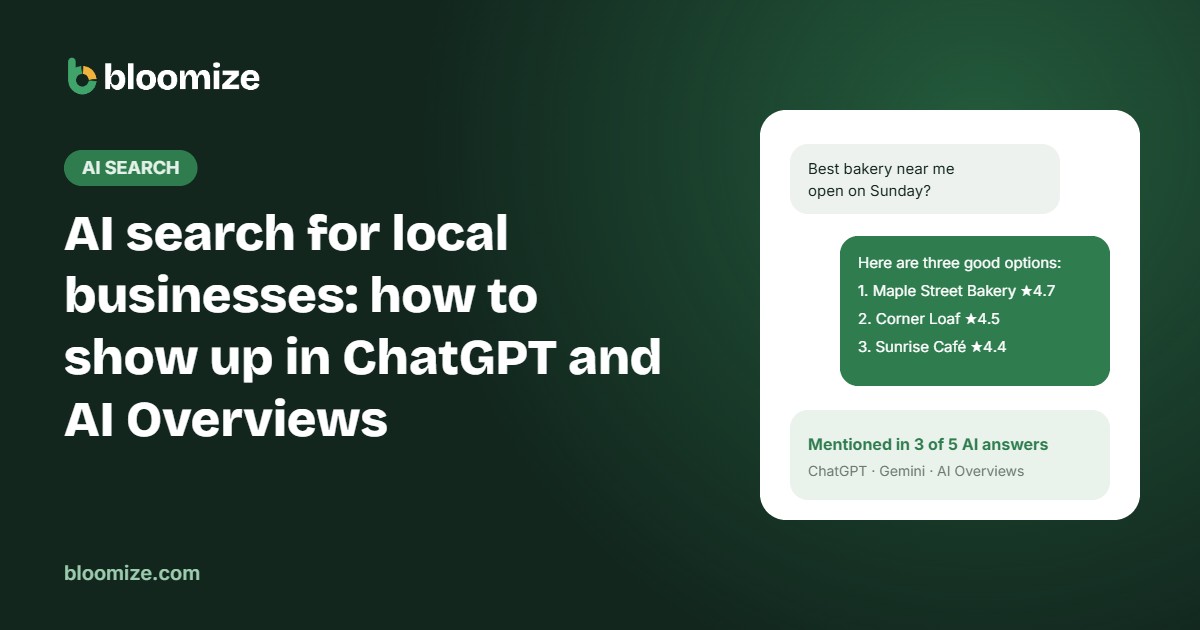
“What’s a good dentist near me that takes walk-ins?” A few years ago, that question went into Google and returned a list of links and a map. Today, many people type it into ChatGPT, Gemini or another AI assistant, or see an AI Overview at the top of Google, and get a short answer that names two or three businesses.
If your business is one of those names, you win a customer without them ever comparing ten websites. If it is not, you may never know you were left out. This guide explains, in plain words, how AI search finds local businesses and what you can do to be included.
How AI assistants decide which businesses to mention
AI assistants do not have a secret list of businesses. They build answers from information that is already available online, and many of them now search the web live before answering. In practice, they lean on the same sources a careful customer would check:
- Your website, especially pages that clearly explain what you do, where and for whom.
- Your Google Business Profile and other listings: categories, hours, services, location.
- Reviews, both the rating and what people actually say.
- Mentions elsewhere: local news, directories, “best of” lists, community sites and industry associations.
Google explains how its own AI features use websites in its guide to AI features and your website. The short version: the same things that make a page helpful and trustworthy for search also make it useful for AI answers.
Step 1: make your website easy to understand
AI tools struggle with vague marketing language. “We deliver excellence in every project” tells them nothing. “We repair and replace water heaters in Pasadena and Glendale, same-day, seven days a week” tells them exactly when to recommend you.
- Give each main service its own page with a clear heading.
- Say where you work, in plain words, including neighborhoods or cities.
- Include practical details: hours, prices or price ranges, booking options, languages spoken, parking.
- Add an FAQ section answering the questions customers ask on the phone.
Step 2: keep your details consistent everywhere
When your business name, address, phone and hours are the same on your website, Google profile, Yelp, Apple Maps, Facebook and industry directories, AI tools can be confident they are looking at the same business. Conflicting details create doubt, and doubt means you are less likely to be mentioned.
Adding LocalBusiness structured data to your website also helps machines read your details correctly. Many SEO plugins can add it for you.
Step 3: earn reviews that describe what you do
AI answers often summarize reviews: “customers praise the friendly staff and fast service.” Reviews that mention specific services, like “they fixed our AC the same day,” give AI more to work with than “great job!”
You cannot tell customers what to write, but you can ask them to mention what you helped with. Our guide on getting more Google reviews explains how to ask without breaking the rules.
Step 4: get mentioned where your customers look
AI assistants trust businesses that other sources trust. A mention in a local news story, a chamber of commerce directory, a respected industry association or a well-known “best of” list is a strong signal. Focus on a few quality mentions rather than hundreds of low-quality directories.
- Join your local chamber of commerce or business association.
- Sponsor or take part in community events that get covered online.
- Ask partners and suppliers to list you on their websites.
- Make sure industry directories in your field have your current details.
How to check your AI visibility
You can test your visibility today. Ask two or three AI assistants the questions a new customer would ask, such as:
- “Best [your service] in [your city]”
- “[Your service] near [neighborhood] open on weekends”
- “Who should I call for [specific problem] in [your city]?”
Write down whether you are mentioned, which competitors are, and what reasons the AI gives. Repeat every month, because answers change. Bloomize’s AI search visibility report runs these checks for you and shows the trend next to your Google results, from the Growth plan up.
What not to do
- Do not fill pages with AI-generated filler. Thin, repetitive content helps neither customers nor AI tools.
- Do not create fake reviews or fake mentions. They violate platform rules and can backfire badly.
- Do not stop doing traditional SEO. Strong Google rankings and a complete profile remain the foundation AI answers are built on.
The bottom line
AI search does not replace the basics. It rewards them. Businesses that explain clearly what they do, keep their details consistent, earn genuine reviews and get mentioned by trusted sources are the ones AI assistants recommend. Start with your website and Google profile, check your visibility once a month, and adjust. Learn more in our glossary entry on AI search visibility.